
Science & The Holy Quran
Fourteen centuries ago, in an era of pre-telescopic astronomy and rudimentary biology, the Holy Quran unveiled cosmic, geological, and biological realities that modern empirical instruments are only now uncovering.
سَنُرِيهِمْ آيَاتِنَا فِي الْآفَاقِ وَفِي أَنفُسِهِمْ حَتَّىٰ يَتَبَيَّنَ لَهُمْ أَنَّهُ الْحَقُّ
“We will show them Our signs in the horizons and within themselves until it becomes clear to them that it is the truth.”
Surah Fussilat • 41:53Published Research Articles
Explore individual research articles detailing Quranic verses, linguistic analysis, and modern peer-reviewed scientific discoveries.
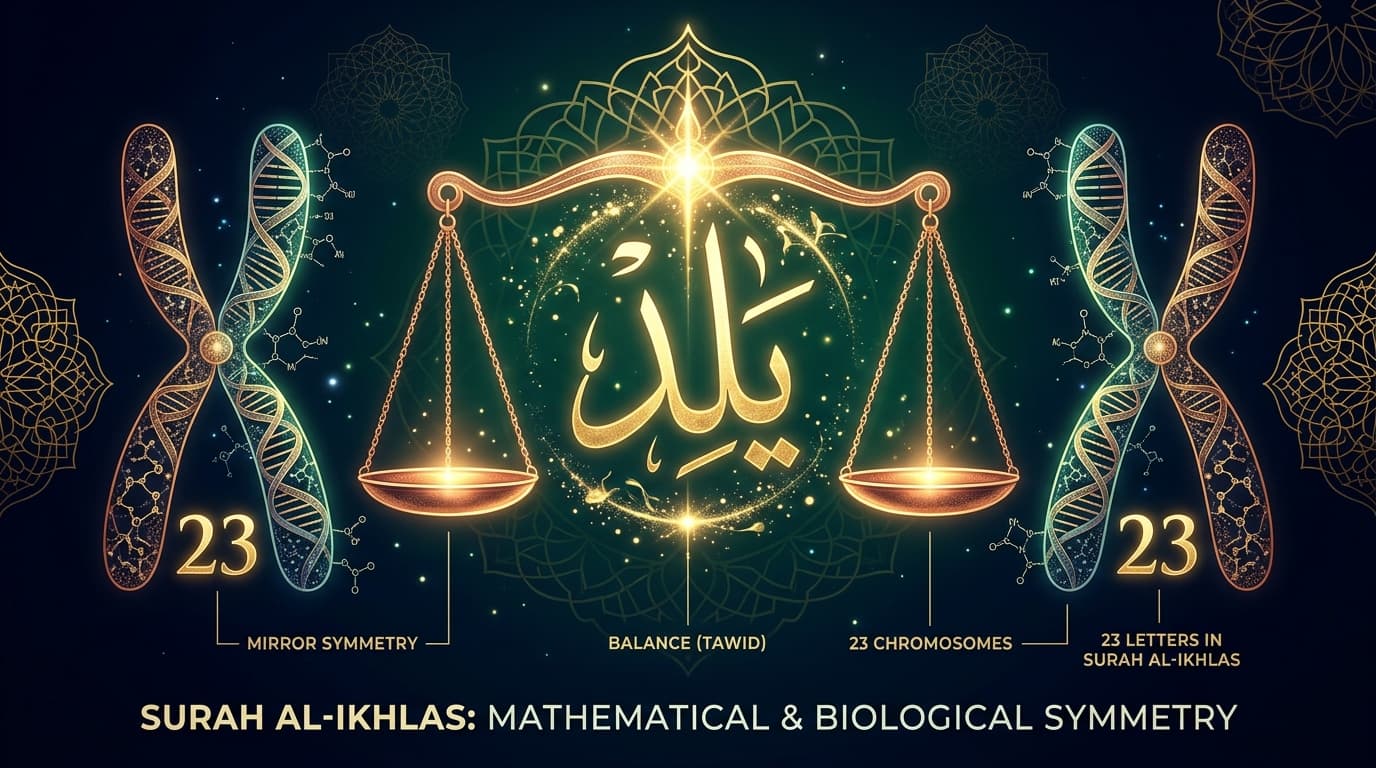
The Quadruple Symmetries of Surah Al-Ikhlas: Chromosomes, Gematria, and the Mathematics of Tawheed
A profound discovery into the multi-layered mathematical and biological architecture of Surah Al-Ikhlas: 47 letters divided into 23 before and 23 after the word 'Yalid' (matching the 23 paternal and 23 maternal chromosomes of human birth), 7 words on either side, identical 16-1-16 vowel balances, and an exact 198 = 198 Abjad gematria equilibrium.
قُلْ هُوَ اللَّهُ أَحَدٌ اللَّهُ الصَّمَدُ لَمْ يَلِدْ وَلَمْ يُولَدْ وَلَمْ يَكُن لَّهُ كُفُوًا أَحَدٌ
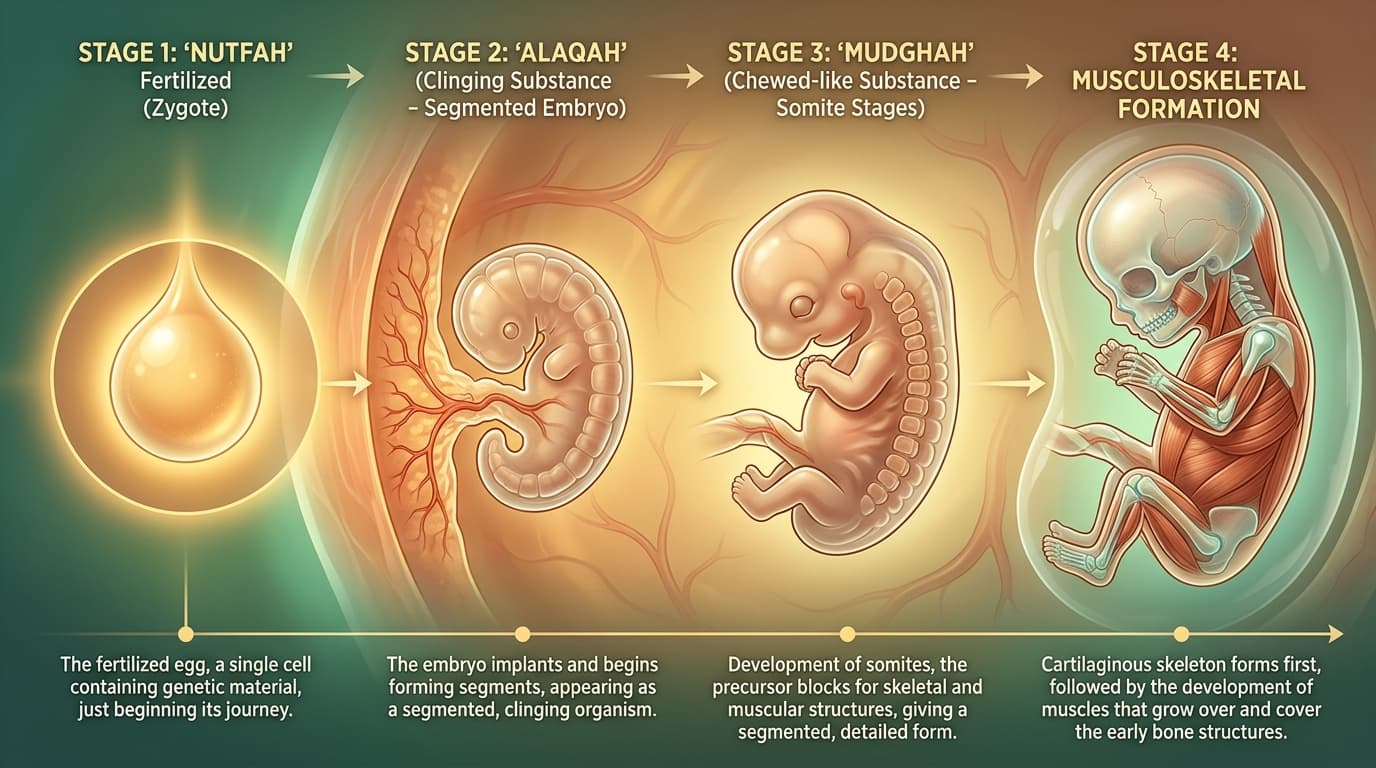
Human Embryology in the Holy Quran: The Step-by-Step Architecture of Intrauterine Life
A comprehensive, easy-to-understand breakdown of the Quranic stages of human development—from fertilization (Nutfah Amshaj), genetic programming (Taqdir), and implantation (Harth), to the clinging leech-like embryo ('Alaqah), somite segmentation (Mudghah), sequential bone and muscle clothing ('Izam & Lahm), and the three anatomical veils of darkness (Zulumat Thalaath)—reviewed alongside 21st-century developmental biology.
وَلَقَدْ خَلَقْنَا الْإِنسَانَ مِن سُلَالَةٍ مِّن طِينٍ ثُمَّ جَعَلْنَاهُ نُطْفَةً فِي قَرَارٍ مَّكِينٍ ثُمَّ خَلَقْنَا النُّطْفَةَ عَلَقَةً فَخَلَقْنَا الْعَلَقَةَ مُضْغَةً فَخَلَقْنَا الْمُضْغَةَ عِظَامًا فَكَسَوْنَا الْعِظَامَ لَحْمًا ثُمَّ أَنشَأْنَاهُ خَلْقًا آخَرَ ۚ فَتَبَارَكَ اللَّهُ أَحْسَنُ الْخَالِقِينَ
The Islamic Philosophy of Science
In the Islamic worldview, the Universe is the Cosmic Book of Creation (Kitab at-Takwin), while the Holy Quran is the Recited Book of Revelation (Kitab at-Tadwin). Both originate from the same Creator; therefore, sound empirical observation of physical realities and divine revelation can never be in genuine contradiction.
The Quran does not present itself as a scientific handbook with mutable formulas. Rather, it employs precise linguistic descriptions of nature to awaken the human faculty of reason (Aql) and inspire contemplation (Tafakkur).
When the Quran references the expansion of space, the layers of the deep sea, the microscopic development of the embryo, or the stabilizing role of mountains, it does so with divine authority that transcended all 7th-century knowledge—reminding humanity across all eras that the One who created the heavens is the One who revealed the Book.
Frequently Addressed Questions
Common inquiries regarding the relationship between modern scientific discoveries and Quranic interpretation.
Does our faith depend on temporary scientific theories?
No. Scientific theories evolve, refine, and can occasionally be revised as instrumentation advances. Our belief in the Holy Quran is founded on divine revelation and spiritual conviction. When established scientific facts align with the literal Arabic expressions of the Quran, they serve as external corroborations of divine truth for open-minded seekers.
Could Prophet Muhammad ﷺ have gathered this knowledge from other civilizations?
Historically and scientifically impossible. The Prophet Muhammad ﷺ was unlettered (Ummi) living in the interior Arabian desert. Greek, Babylonian, and Roman works of that era contained glaring cosmological and medical errors (e.g., flat earth supported by columns, spontaneous generation, homunculus theory). The Quran contained none of these contemporary misconceptions, while accurately predicting microscopic and astronomical details verifiable only through 20th-century electron microscopes and space observatories.
How should a Muslim approach scientific inquiry?
The Quran explicitly commands humanity over 750 times to observe, reflect, and investigate the laws of the universe. Islamic civilization birthed the scientific method through luminaries like Ibn al-Haytham (optics), Al-Biruni (geodesy), and Jabir ibn Hayyan (chemistry)—viewing scientific research as an act of worship and appreciation of Allah's cosmic design.